
SAWC Release and Transfer Paths
St. Anthony Work Camp is part of IDOC. Its residents are serving state sentences, and the correct question is what status followed the person’s departure from SAWC. A resident may transfer to another prison and remain “In custody.” Placement at the Idaho Falls Community Reentry Center also remains IDOC custody even when work or services take place in the community.
Parole changes the public result to “In community” and an active detail can show Released to Supervision. Final satisfaction of the IDOC sentence produces a “Discharged” result with a date. These outcomes are not interchangeable. A facility move says where custody is being served. Released to Supervision describes placement under parole or probation oversight. Discharged describes sentence satisfaction in the public IDOC system.
Confirm a SAWC Release
Begin with the official IDOC Resident/Client Search. Search by last name and optional first name, or by IDOC number. Partial searches require at least the first two last-name letters or the first three IDOC-number digits. Compare the IDOC number, full name, and birth year before opening a result.
- Locate the correct person and read the exact result status.
- Open an active detail to see the location or supervising district and sentence rows.
- For community placement, look for “In community” and Released to Supervision.
- For sentence completion, look for “Discharged” with its date.
- Compare any parole decision with the later IDOC status before reporting a release.
IDOC says results update daily, but also warns that status, location, and scheduled termination can change fast. A future date or a Commission decision is not enough. Confirm the status after that date. If the result still says “In custody,” do not announce a release.
SAWC Status Fields Explained
Idaho uses several date labels, and none should be renamed “release date” without context. Each answers a different question. Their distinctions are especially important for SAWC because a person can leave its grounds while still remaining within IDOC custody.
| IDOC field | What it supports |
|---|---|
| Parole Eligibility Date | The earliest point for parole consideration, not promised release. |
| Tentative Parole Date | A conditional Commission target after a grant. |
| Released to Supervision | The most recent placement on supervision by a court or Commission. |
| Sentence Satisfaction Date | The scheduled endpoint of an active sentence. |
| Discharged [date] | Retrospective public evidence that the IDOC sentence was satisfied. |
A tentative date can pass without release if programming, an approved plan, paperwork, or another requirement is incomplete. Released to Supervision is stronger proof of actual community placement. A later Discharged entry is different from parole and may omit conviction detail under IDOC’s public-search design.
St. Anthony Work Camp Contact
Contact the facility for operational questions about a current resident, but use the public status search or an IDOC record for a durable release conclusion. Personnel can change, so the agency contact is more reliable than an old staff name.
St. Anthony Work Camp
125 N 8th West
St. Anthony, ID 83445
208-624-3775
sawc@idoc.idaho.gov
A caller should have the full name and IDOC number when available. Ask whether the person remains assigned to SAWC, moved to another IDOC location, or entered community supervision. The facility cannot turn a tentative date into a guarantee. For sentence documents or formal release material, use IDOC’s records channel.
Request SAWC Release Records
The IDOC public-record portal is the proper route for state sentencing and release documents. Identify the person, IDOC number, relevant Fremont County case if known, and the narrow date range or record sought. Useful targets can include sentencing records, a release or supervision-placement record, and records that explain a transfer.
IDOC Sentencing Records processes judgments and credits, but it cannot change a court sentence. If a public-search field appears wrong, use the IDOC information-request or correction route and identify the precise field. A court judgment still comes from the court that entered it. Asking one office to correct another agency’s source record can slow the answer.
Note: An IDOC records response documents the state event requested; it does not replace a separate county booking record.
Inside SAWC State Custody
IDOC describes SAWC as a 400-bed work camp for minimum- and community-custody men. Its location in St. Anthony can cause confusion with the Fremont County Jail, yet the operators, records, population, and release systems are different. A county detainee may transfer into state custody after judgment. That county departure is not a community release.
The label “community custody” describes a lower custody classification. It does not mean the person lives free of IDOC custody. The public IDOC status remains the cleaner indicator. “In custody” controls even if work takes place beyond a secure perimeter. “In community” plus the supervision date supports the later change.
View the Official SAWC Page
The official IDOC facility page provides the source view for SAWC’s role and contact information.
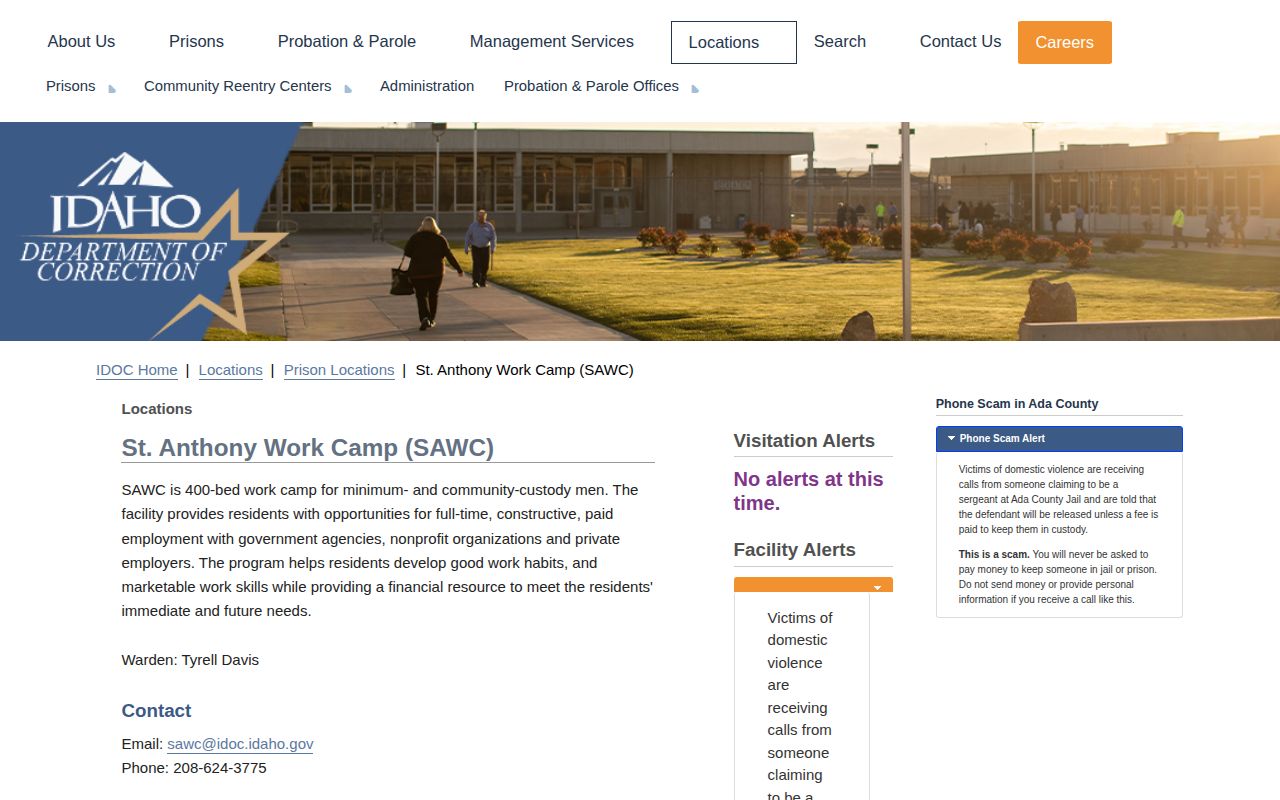
The image identifies the state correctional source. It does not show that any named resident was released, so a person-level conclusion still requires the IDOC search and applicable records.
SAWC to IFCRC Is Custody
The Idaho Falls Community Reentry Center serves eastern Idaho and can be a step between prison and later supervision. Its residents may work or receive services in the community, but residence there is still an IDOC placement. A move from SAWC to IFCRC is therefore a transfer within the state system.
Search the active IDOC detail after the move. If it lists IFCRC or another correctional location and says “In custody,” state only that the SAWC assignment ended and custody continued elsewhere. Wait for “In community” and Released to Supervision before describing parole or probation placement. The sibling IFCRC custody-status guide explains that transition.
SAWC Parole Decision Checks
The Idaho Commission of Pardons and Parole publishes hearing schedules and Notices of Action Taken. A notice may list a Tentative Parole Date. The word “tentative” must stay attached because the Commission requires completion of programming, an investigated and approved parole plan, and final paperwork.
On or after the target, search IDOC again. “In community” with Released to Supervision creates a coherent record of the grant followed by actual placement. If the status remains “In custody,” contact IDOC or the Commission rather than speculate. Eligibility, a hearing, and a grant are steps in the process. None alone establishes the day the person left state custody.
SAWC Sentence Discharge Proof
A “Discharged” result with a date supports satisfaction of the IDOC sentence. It is not the same as parole. IDOC says discharged names remain searchable while convictions do not display, so the result may not open the detail that an active record provides. Use iCourt or requested sentencing documents for case history, subject to court restrictions.
A prior Sentence Satisfaction Date was a calculated endpoint. The later discharged status is retrospective. New cases, holds, or another jurisdiction remain separate questions. The safest statement identifies the exact system and date: IDOC shows the sentence discharged on the recorded date. That precision avoids turning one completed state sentence into a claim about every possible legal matter.
SAWC Sentence Record Reconciliation
An active IDOC detail can show the offense, sentencing county, case number, sentence status, Parole Eligibility Date, Sentence Satisfaction Date, and next hearing information. Those fields allow a SAWC result to be compared with the court judgment without merging two different records. The court establishes the sentence. IDOC applies the judgment and recorded credits within the correctional system. If the dates appear inconsistent, obtain the judgment and the IDOC sentencing record rather than selecting the date that seems most favorable.
Idaho’s unified sentence has a fixed minimum and may include an indeterminate part. Under Idaho Code section 19-2513, ordinary parole is not available during the fixed portion. The research found no general rule that a person is released after serving 85 percent of an Idaho sentence. Extraordinary meritorious reduction under section 20-101D is narrow and concerns exceptional conduct, not routine program participation. It should not be used as a general SAWC release calculator.
Multiple sentences, credited jail time, concurrent or consecutive terms, corrected judgments, and later court action can affect the displayed calculation. A Parole Eligibility Date remains an eligibility marker. A Sentence Satisfaction Date remains the scheduled sentence endpoint. Neither substitutes for the later “In community” status with Released to Supervision or a retrospective “Discharged” result. Keeping that sequence intact is the safest way to report what happened after SAWC.