
Fremont Has No 72 Hour List
Fremont County provides no official 72-hour release view. The Sheriff page, agency directory, county site map, and targeted official-site searches produced no adult booking roster, recent-release filter, archive, mobile jail app, or public booking-photo gallery. With no feed, there is no published refresh schedule, retention period, column set, or weekend rule. A three-day table of names presented as a Fremont County feed would be unsupported.
The sound alternative is a date-range request for records the jail already holds. Fremont County’s JustFOIA portal is the written route. VINE remains the quick event channel for a known person, and the jail can say whether county custody ended through release or transfer. Idaho iCourt can supply the order or case event behind the custody change. These sources overlap, but each answers a different part of the question.
Request Fremont Three-Day Records
Choose the beginning and end of the period before opening JustFOIA. Include times and the time zone when a midnight boundary could matter. A focused description might ask for “existing Fremont County Jail release records with release timestamps from [start date and time] through [end date and time], including the person’s name, booking number, release date and time, release disposition or type, and transfer destination where recorded.” Ask for electronic delivery.
- Set an exact start and end for the three-day period.
- Open Fremont County’s public-record request portal.
- Select the Sheriff or closest jail-record category.
- Ask for existing release records and the relevant fields.
- Clarify or narrow the request if the custodian needs a booking episode.
- Check each result against VINE, the jail, and the relevant court case.
The county does not promise to produce a report that it does not maintain. A record custodian may provide responsive documents, explain that no responsive record exists, apply a lawful restriction, or state an allowable cost. Fremont publishes no special release-record price or retention rule. Juvenile, sealed, shielded, and protected investigatory material follow different access limits.
Fremont 72 Hour Record Fields
The table describes useful request fields, not columns in an online list. Some facts may sit in different systems, and disclosure depends on the record and law. Identity and booking details should be precise enough to prevent a person from being linked to the wrong episode.
| Field to request | How to read it |
|---|---|
| Name and available identifier | Supports a careful identity match. |
| Booking number | Links all facts to one jail stay. |
| Booking agency and time | Identifies who placed the person in custody and when. |
| Release date and time | Places the event inside or outside the chosen range. |
| Release disposition or type | May identify bond, time served, probation, dismissal, or another reason. |
| Releasing facility | Confirms which custodian’s control ended. |
| Transfer destination | Prevents a custody transfer from being called community release. |
| Bond and court disposition | Adds context that should be reconciled with iCourt. |
A release record is historical. It says what happened in a defined booking episode, not where the person is today. A new case, hold, warrant, transfer, or later arrest can change current status after the recorded event.
Why Fremont Needs Wider Dates
A 72-hour span can catch an event when the exact day is unknown, when a custody change occurred near midnight, or when several days need to be reviewed together. It is also useful after a weekend or holiday because a requester can define the whole period instead of guessing which single day holds the record. No Fremont source establishes a special weekend release schedule, processing delay, or holiday practice, so the wider window should not be presented as proof of how the jail operates.
Set the range based on the question. If VINE sent an alert late on Friday, a request through Monday may capture the booking-release entry and related transfer detail. If a family member last had contact two days ago, a three-day range can reduce uncertainty. In either case, ask for exact timestamps. A court order may be entered before or after the physical custody event, and a VINE alert can serve as the trigger rather than the final record.
For a current same-day event, the Fremont County 24 hour release guide uses a faster person-specific VINE and call sequence. The 72-hour route places more weight on the written date-range request.
Verify Each Fremont Custody Change
Read every release as an event from a named facility. A person can leave Fremont County Jail for the community on bond, pretrial release, time served, probation, dismissal, or another court-authorized disposition. The person can also leave because IDOC, another jail, the United States Marshals Service, or ICE assumed custody. Only the first set represents community departure from the jail.
Call Fremont County Jail at 208-624-4482 with the name and booking period. Ask whether the recorded event was community release or transfer, and request the transfer agency when appropriate. Then review the court register for the bond order, dismissal, judgment, sentence, or other authority. A jail timestamp establishes the operational event more directly than a court order that merely authorized it.
When the trail leads to IDOC, use the Resident/Client Search. “In custody” means state custody continues. “In community” with Released to Supervision supports community placement under felony supervision. “Discharged” with a date supports satisfaction of the IDOC sentence. St. Anthony Work Camp and Idaho Falls Community Reentry Center are IDOC custody settings, even though SAWC is local and IFCRC residents may take part in approved community activity.
Use Fremont VINE Carefully
Fremont County’s own VINE page says county jail and prison booking systems provide near-real-time custody information and notification options. Search one person by name or identifier, match the agency and available identity facts, and read the status. A notification of release or transfer is a prompt to confirm the event, not a browseable log of all people who left during the prior three days.
VINE is strongest for a known person and a changing status. It is not the archive for reconstructing a whole weekend. If the event indicates a transfer, move to the receiving system. IDOC covers state custody and felony community supervision. The Bureau of Prisons locator applies to federal imprisonment. ICE’s locator is a separate and limited channel for immigration custody. The local jail record remains the source for how the Fremont booking ended.
The official Fremont County Sheriff page provides the local contact context and contains no 72-hour feed link.
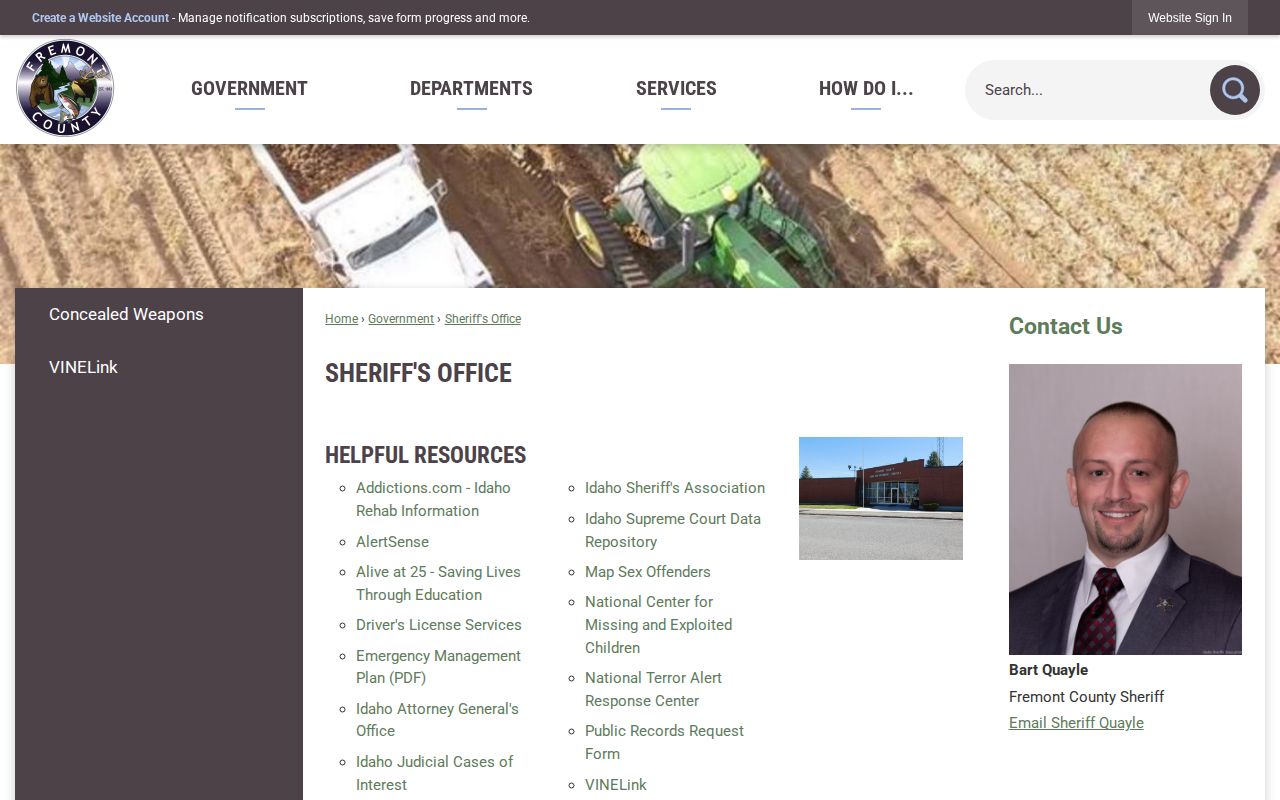
The page image supports the channel finding only. It supplies no person-level release proof.
Fremont Records Can Conflict
A VINE event, jail record, and court docket can be posted or updated on different schedules. Start with the source closest to the fact. The jail record controls the recorded custody departure and timestamp. The court order explains the legal basis. VINE supplies the timely alert. IDOC or another receiving agency shows whether custody continued elsewhere.
Names and dates should match before records are combined. If a VINE alert appears after an iCourt bond order, ask the jail whether the release was on bond or whether a hold caused transfer. If IDOC later lists the person as In custody at SAWC, do not call the jail departure a return to the community. If no public result appears, say that no matching result was located and continue through the official custodian.
Absence is weak evidence. Spelling, a different jurisdiction, a system delay, restricted juvenile data, shielding, or an archive limit can all cause a miss. Fremont’s lack of an adult roster makes direct confirmation and a narrow records request even more important.
Keep the Fremont Range Precise
Do not let “last 72 hours” drift while a request is prepared. Write the fixed beginning and ending timestamps. If the period is meant to cover Friday through Monday, state those dates rather than relying on a rolling count that will change by the time staff read it. A fixed range makes the response easier to compare with VINE alerts and court entries.
For one person, include a date of birth if known and a booking number or approximate booking date. For all existing release records in a range, avoid broad extra demands that obscure the central request. The county may need to redact restricted facts, and the absence of a requested field does not prove it never existed elsewhere. The goal is an accurate custody timeline, not a fabricated public roster.