
Fremont County Scheduled and Actual Release Dates
A scheduled date is a forecast or legal milestone. An actual release is a completed custody event. The source must identify both the person and the system involved. Fremont County Jail, IDOC, the Commission, and the court each document a different part of that timeline.
Parole Eligibility Date and Tentative Parole Date look forward. Released to Supervision and a jail release timestamp document events that have occurred.
A transfer also ends custody at one facility without putting the person in the community. Leaving Fremont County Jail for St. Anthony Work Camp is a move into IDOC state custody. Moving from SAWC to Idaho Falls Community Reentry Center can still be an IDOC custodial placement. Always identify the next custodian.
How to Find a Fremont County Projected Release
Use the route that matches the person’s present legal status. A broad name search can mix county detainees, state prisoners, supervisees, and people whose sentences are complete.
- Identify the last known facility and case. Search iCourt for the Fremont judgment, bond order, sentence, amended order, or other action.
- For state custody, open the IDOC Resident/Client Search. Enter at least two last-name letters, with an optional first name, or the first three digits of the IDOC number.
- Match the full name, birth year, and IDOC number. Open the active detail and keep each date label intact.
- For a Commission decision, match both name and IDOC number on the official notice. Treat any Tentative Parole Date as conditional.
- For a county sentence, obtain the judgment and ask Fremont County Jail records staff for the recorded computed date and credits.
- For a pretrial detainee, follow the bond and court orders. There is no sentence-derived projected date before sentencing.
- After any expected date, check the later IDOC status, jail release record, or next-custodian record to confirm what actually happened.
Note: IDOC updates results daily but warns that location, status, and scheduled termination can change quickly.
The official IDOC search is the state source for Fremont County sentence and supervision dates.
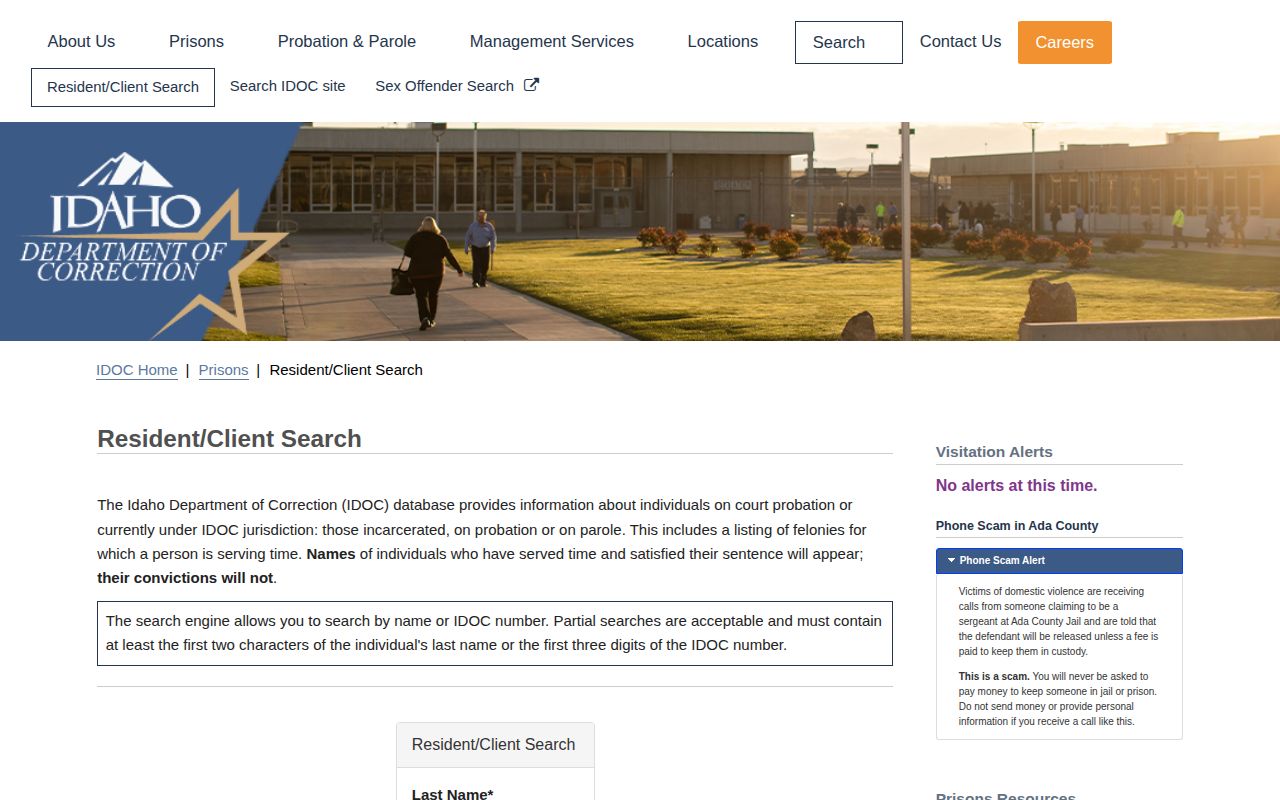
The search form starts the inquiry; the matched detail and later status provide the useful date context.
Four Idaho Release-Date Concepts for Fremont County
IDOC does not publish one field literally labeled “Projected Release Date.” Idaho splits the issue into distinct milestones. A fifth field, Next Parole Hearing Date, is an administrative schedule rather than a release date.
| Official field | What it means | What it does not prove |
|---|---|---|
| Parole Eligibility Date | Earliest point for discretionary parole consideration, generally the start of the indeterminate portion | That parole was granted or release will occur then |
| Tentative Parole Date | Conditional target after a Commission grant | That programming, plan approval, and paperwork are complete |
| Released to Supervision | Date most recently placed on supervision by a court or Commission | The exact Fremont jail booking-release minute in every case |
| Sentence Satisfaction Date | Scheduled satisfaction of the active sentence | The day secure custody necessarily ends |
| Next Parole Hearing Date | Scheduled Commission hearing | Eligibility, grant, or release |
Parole can occur during the indeterminate portion before sentence satisfaction. A hearing can be scheduled before the eligibility date as part of the Commission calendar. A tentative date can pass while the person remains “In custody.” These are not contradictions when each field is read for its limited purpose.
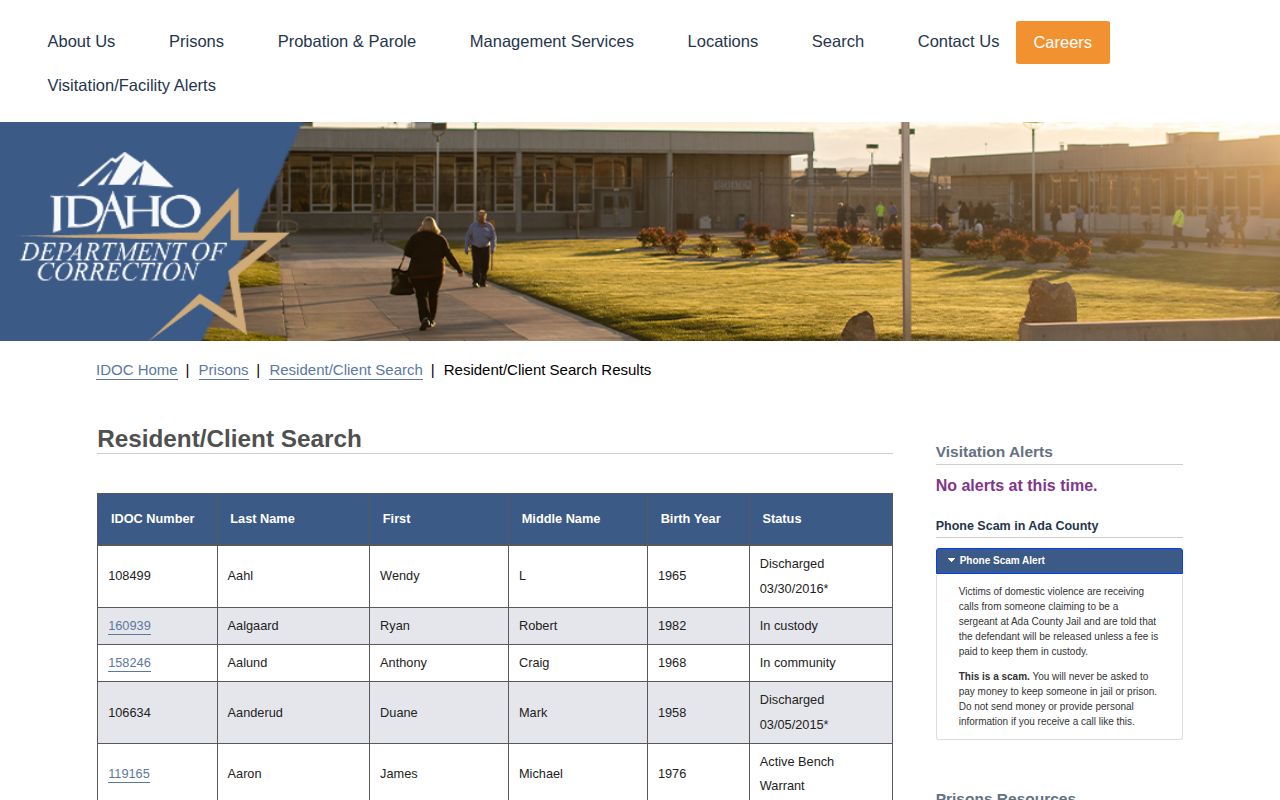
Birth year and IDOC number help prevent a namesake result from being assigned to the wrong Fremont County person.
Idaho Sentences Do Not Use a Generic 85 Percent Rule
Idaho Code §19-2513 uses a unified sentence with a fixed minimum and an indeterminate portion. Ordinary parole is not available during the fixed portion. Once the indeterminate portion begins, the person becomes eligible for discretionary Commission consideration, not entitled to release.
A sentence with a six-year fixed portion and a four-year indeterminate portion is therefore not well described as a ten-year term with an 85-percent exit point. The fixed six years controls ordinary initial parole eligibility after lawful credit and adjustments. The public PED should be read with the judgment rather than replaced by an imported percentage.
Idaho Code §20-101D is exceptional, not a routine monthly credit plan. It concerns extraordinary heroism or outstanding service, such as saving life, preventing major loss during a riot, or preventing escape. Its maximum of 15 days per sentenced month is a cap on such an extraordinary award, not a promise of regular credits. Idaho Code §20-101A’s older monthly good-time scheme is limited to offenses before July 1, 1986.
Fremont County research found no current local good-time policy, public county calculator, or general Idaho 85-percent rule. Use the judgment and agency calculation.
What Can Change a Fremont County Release Date
A date can move because the legal inputs or correctional events change. The reason should come from the court, IDOC, Commission, or jail record, not a guess based on an older portal view.
| Change | Likely effect | Where to verify |
|---|---|---|
| Corrected or amended judgment | Can change sentence structure or credit | iCourt and the court document |
| Jail or retained-jurisdiction credit | Can alter IDOC calculation | IDOC Sentencing Records |
| Concurrent or consecutive terms | Changes which term controls | Judgment and IDOC sentence rows |
| Parole grant or denial | May create a tentative date or defer release | Commission notice |
| Programming or parole-plan issue | Can delay or void a tentative date | Commission and IDOC |
| Forfeiture, absconding, or violation action | Can affect full-term computation or status | IDOC, court, and supervising district |
| Detainer, hold, or transfer | May prevent community release | Releasing and receiving custodians |
IDOC Sentencing Records reviews judgments, processes credits and parole forfeiture, and updates calculations. It cannot rewrite a court sentence. When a field seems wrong, determine whether the court’s judgment or IDOC’s implementation is disputed before seeking correction.
Fremont County Jail Dates and Pretrial Custody
A person held before conviction has no sentence-based release date. Bond, a judicial release order, dismissal, another case, and a hold can determine when departure occurs. A future court date is not a promised jail release date. A bond order is legal authority, while the jail record supplies the physical release time and disposition.
For a county sentence, ask for the recorded projected or computed release date and the credits applied. Fremont County does not publish a local calculator or policy that permits an outside calculation. Provide a full name, birth date when appropriate, booking number or date range, and case number so the answer applies to the correct episode.
A release from Fremont County Jail can instead be a transfer to IDOC, another jail, the United States Marshals Service, or ICE. The release record should identify the disposition or next agency when that field exists. Do not report community freedom from disappearance from a roster, especially because Fremont publishes no adult roster or release archive.
SAWC and the Fremont County Transfer Trap
St. Anthony Work Camp is physically in Fremont County but is an IDOC state prison. Minimum or community custody describes classification, not release. A person can leave the county jail for SAWC, leave SAWC for another prison, or move to a community reentry center while remaining “In custody” in IDOC.
This local distinction makes the four Idaho date concepts especially important. PED can arrive while the person remains at SAWC. A Commission grant can produce a Tentative Parole Date, but placement is not confirmed until the required steps finish and IDOC changes the status. Released to Supervision is retrospective evidence of community placement. SSD concerns sentence satisfaction, which can happen later.
Does leaving SAWC prove parole? No. The move might be an internal transfer. Read the IDOC location and status, then look for Released to Supervision or a discharged result rather than inferring release from a facility change.
Confirming Fremont County Release After the Date
If a Tentative Parole Date passes, search IDOC again. “In community” paired with Released to Supervision supports actual placement. If the result still says “In custody,” do not announce release. Programming, plan approval, paperwork, rescission, or another condition may have prevented it, and the responsible agency should explain the current status.
A “Discharged [date]” row is the cleanest public IDOC indicator that the sentence has been satisfied. IDOC retains the name but omits convictions for a person who satisfied the sentence, so use iCourt or an official record for the underlying case. An active detail may no longer be available.
VINE can alert users to a custody change, but a notification can compress a transfer into a status event. The Fremont County VINELink status guide explains notification verification. For the full jail, court, and state sequence, use the Fremont County released-inmate lookup.
Note: A projected date answers “when might this happen”; only the later originating record answers “what did happen.”
Resolving a Disputed Fremont County Release Calculation
A public date can be accurate to the information IDOC holds while still differing from a person’s copy of the judgment. Resolve that conflict by tracing each input instead of choosing the earlier date. Obtain the judgment and any amended judgment from the court. Note whether terms run concurrently or consecutively, the fixed and indeterminate portions, the credited jail time, and any retained-jurisdiction credit. Then compare those terms with the sentence rows in the matched IDOC detail.
IDOC Sentencing Records processes judgments, calculates sentences, applies jail and retained-jurisdiction credit, handles parole forfeiture, and updates correctional data. It cannot alter the sentence imposed by the court. If the court document itself needs correction, that issue belongs in the court process. If IDOC appears to have implemented an accurate judgment incorrectly, use IDOC’s information-request route and identify the case number, IDOC number, disputed field, and supporting order.
The source date also matters. IDOC warns that status, location, and scheduled termination can change quickly. Save the exact field label and the day it was checked, then return to the live record before relying on it. A cached result, an older Commission notice, and a current active detail can reflect different stages of the same case.
Do not solve a discrepancy by applying a general percentage or by counting calendar days from a news report. The fixed term, lawful credits, sentence structure, later orders, and correctional events determine the calculation. For a Fremont County jail sentence, the same evidence rule applies, but the question goes to the jail records staff and court because no local public calculator was found.